
A Perfect Tree?
Three keys to understanding the growth of trees
Let’s explore what makes trees unique. We know that trees are the largest, tallest, longest-lived of all organisms. We will be exploring these subjects in upcoming Our Trees stories. For the next few weeks, I want to explore three aspects of tree growth that are not much talked about, but are essential to understanding why trees are so successful. Next week, we will discuss tree longevity and ask “are trees immortal?” (If you can’t wait, the answer is yes, as long as we understand the biological meaning of mortality). The following week we will ask “how do trees heal their wounds and injuries?” (The answer is that they don’t). Today, let’s look at a tree that appears to us as a perfectly formed, healthy tree.
A note for readers: We appreciate all our new subscribers. As you might imagine, Our Trees takes a considerable amount of time and effort. I would be very grateful if some of you could take on a paid subscription. This will free up my time from other work to make this the best place for discussions of the lives of trees and their relations to us. Your paid subscriptions will fuel Our Trees.
Here is the tree we want to visit. It is an enormous bur oak, Quercus macrocarpa, on a farm in the Bluegrass of Kentucky. It is over 400 years old (based on dendrochronology of this and nearby trees) and is part of the woodland pasture ecosystem that predates the arrival of whhite settlers. I was awestruck when I found this tree. It is not the largest nor the oldest oak in our woodland pastures, but it has spectacular shape, with its broad crown atop a stout stem. It’s a perfectly formed tree, don’t you think?
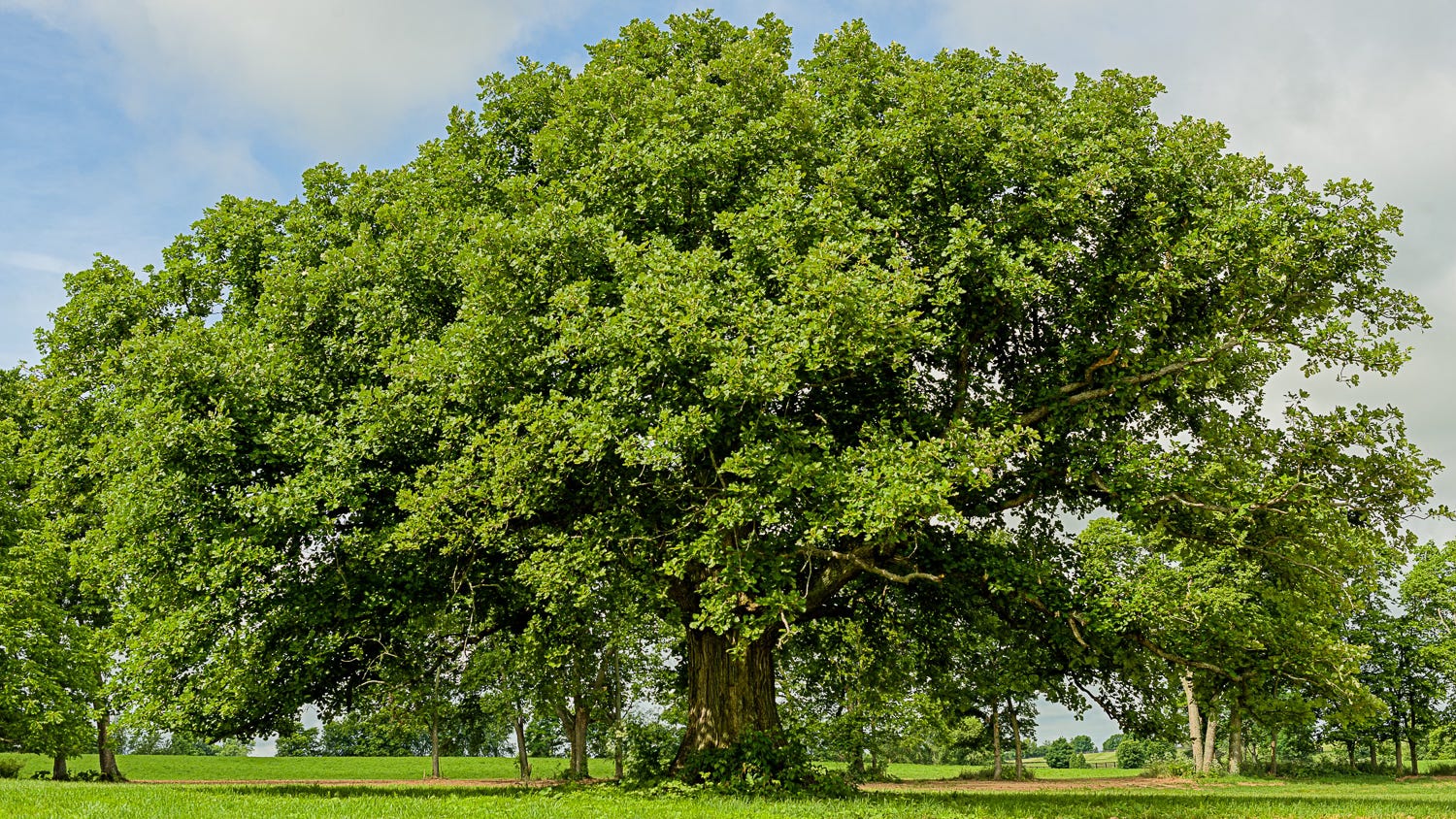
Let’s look at the top of this fine tree.
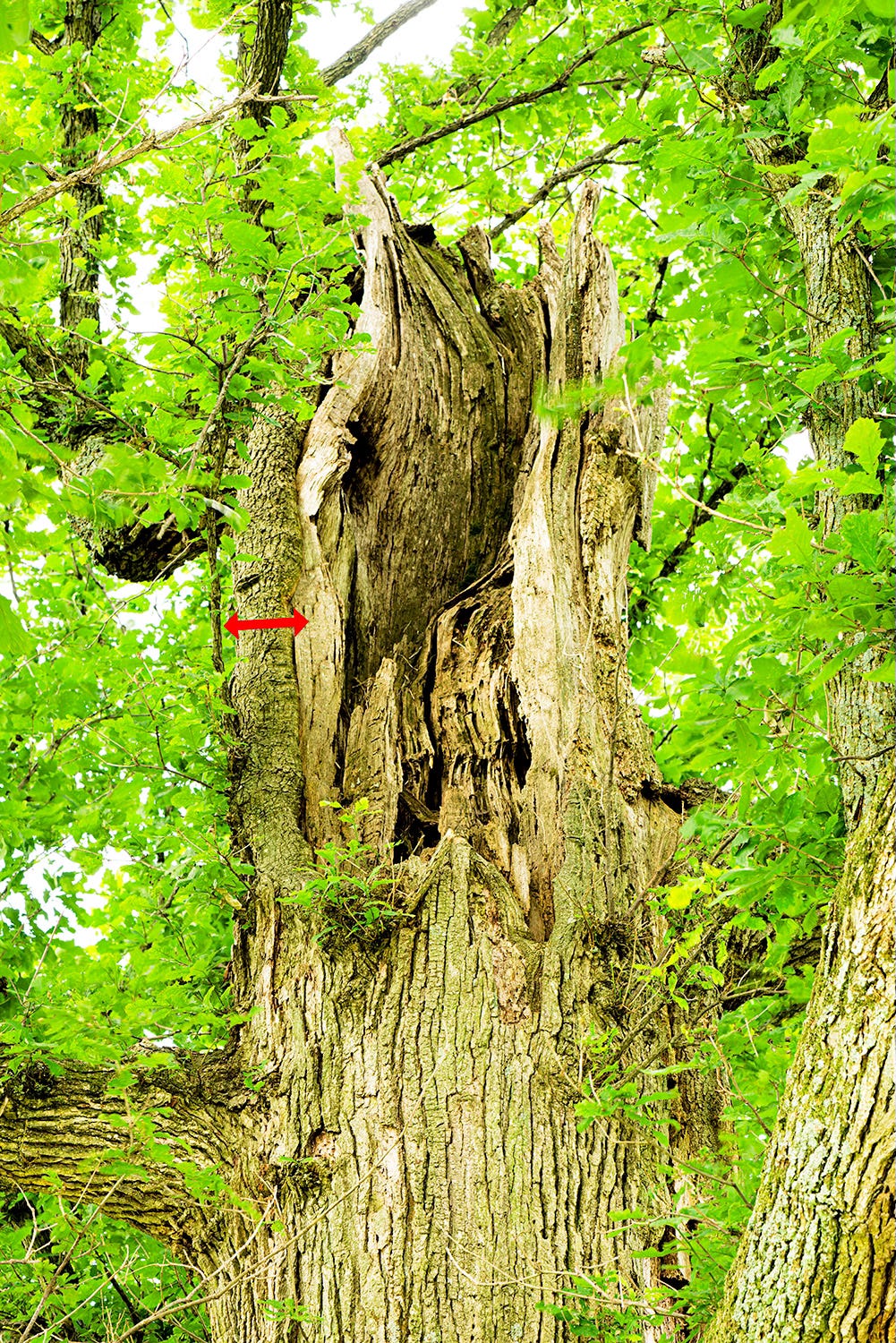
So, it isn’t a perfect tree, is it? It is, though, a perfect illustration of why trees live so long and become so large. This tree was struck by lightning about 100 years ago. We know the date by counting rings in the roll of bark indicated by the red arrow. The center of the tree is heavily decayed, but the tree as a whole continues to thrive.
What did this tree look like right after it was struck? All the branches of the tree were above the lightning strike, so the tree looked like a large stick. For reasons we will discuss later, trees maintain millions of clusters of stem cells below the bark. These are inhibited from growing by the upper branches. As soon as the upper branches were gone, the stem cells began producing new branches. These new branches gave rise to the spectacular crown we see today.
This amazing ability to produce a new crown after damage is a big part of why trees live so long.
Now you have some understanding of the remarkable ability of trees to survive in the face of great stress and injury. I’m sure you have questions. Post them here, and we will answer all of them after the third story in this series. In the meantime, please register for a paid subscription of you are able. This will ensure that we can continue with Our Trees.
See you next week!
What an amazing tree! Thanks for the explanation too, i didn't know that.
Near Edinburgh, Dalkeith Country Park has a lot of ancient oak trees that are also quite magnificent.
There’s much to be said for adventitious budding during times of stress. Bravo oaks.