
Climate Change and the Summer Flush in Trees
I am publishing several related stories this week, about trees and climate change and the range of trees. These are for all subscribers, but I hope some of you will support our work by becoming paid subscribers. Thank you! Note that a version of this story appeared in Our Trees last year, but the other stories this week are new.
Note: this story comes with a homework assignment for you. Read to the end.
When Spring arrives, tree buds pop open to grow leaves, stems, and flowers. A bud is a compact, folded shoot. When it opens in Spring, the leaves expand, the shoots lengthen, and flowers come out from some buds. All of these - the leaves, shoots, and flowers, were formed the previous year.


Tree buds opening in spring, expanding leaves and shoots laid down last year. Most then stop.
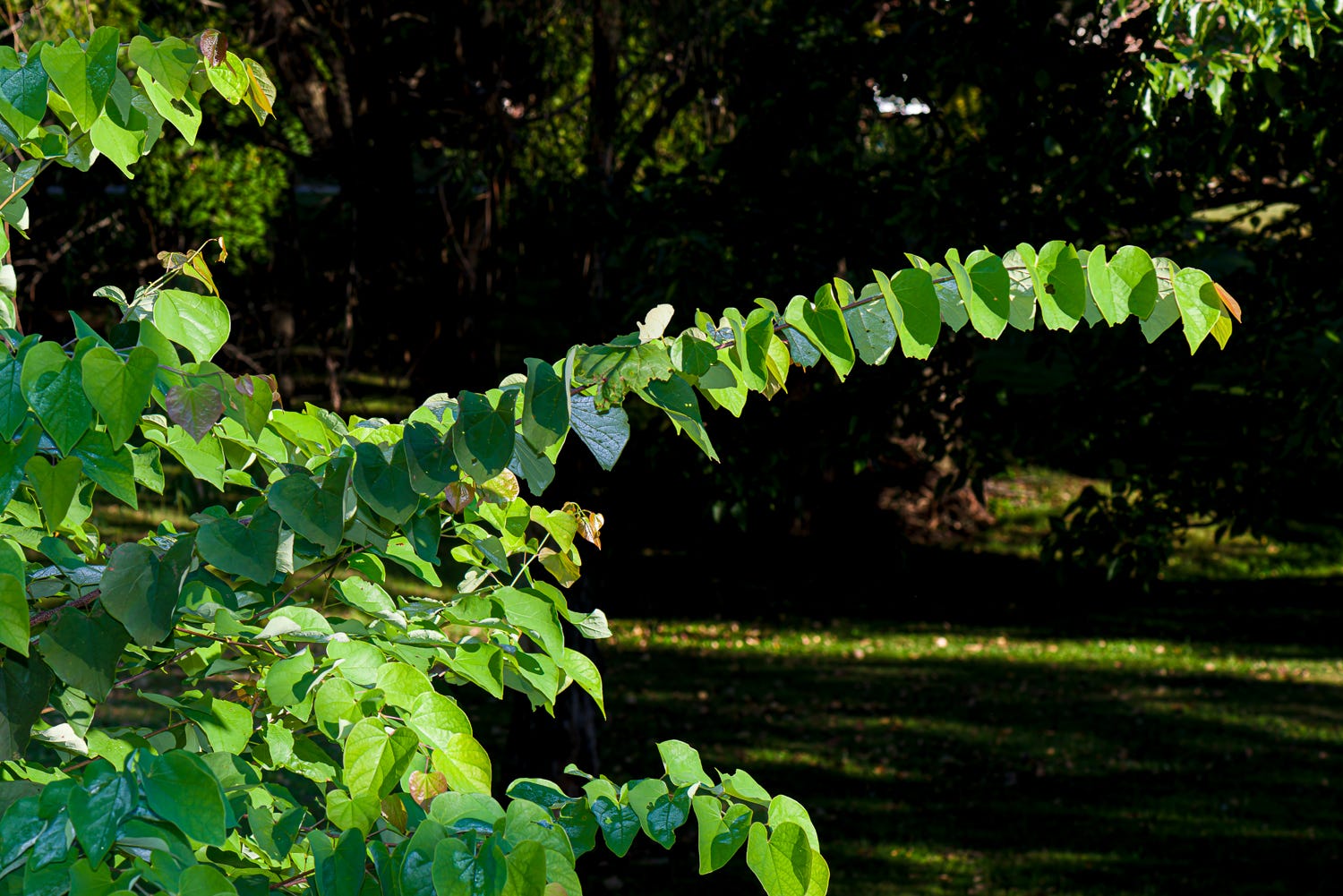
What happens next is not what we may think: the tree stops. In a few fast-growing trees like the redbud pictured below, growth continues, the stem lengthens, and new leaves grow. Most trees don’t do that. They stop, form a bud, and begin laying down leaves for next year. Shoot growth in most trees stops before mid-summer. In slow-growing trees like flowering dogwood, growth is finished in May.
In some trees, if there is a dry spell in summer followed by a rainy spell, the buds laid down for next year sense the nice conditions, pop open, and begin growing, creating a second flush of growth. When I began studying trees in the Eastern Deciduous Forest, a second flush was a rare event, happening once every 10 years or so. Now, it happens nearly every year.
I have boxes full of my bright yellow field notebooks that span my entire career since I was an undergrad. I have been suspecting for some time that climate change produces wetter summers and makes second flushes more likely. I went through my decades of field notes and found that this is correct: second flushes are now an annual event, at least in Kentucky, and throughout most of the eastern deciduous forest.
Here are some of the results. Now, following summer rains, tree buds open and produce a large second flush of growth. Very often, these late leaves lack nutrients and are pale, yellow, or red. They are easy to see, even across an entire landscape. Let me be clear: from my notes, I know that second flushes were uncommon until the mid 1990s, and since 2015, they occur every year in many tree species.


Does this mean that our wet conditions are allowing trees to grow more, or for a longer period? Yes, there is little doubt that eastern forest trees have a longer growing season and are growing more. But what about the yellow or pale leaves? Ah, there is a problem. When buds open in spring, the tree has been accumulating nutrients like nitrogen through the fall, winter, and early spring. Roots do not have a dormant period, and grow as long as soil temperature is adequate. (I’ll say more about this in a future story). That means that a tree is taking up and storing nutrients during most of the time that leaves are not growing. When buds open in the spring, the new leaves have access to lots of stored nutrients and are deep green. By the time of a second flush, these nutrients have been used up, invested in the first flush of leaves. Hence the yellow or pale second flush. Is stressful to the trees to produce leaves without sufficient nutrients? I think so, but don’t have evidence to support that.
In European oaks with one to three flushes of growth, the leaf chemistry confirms what we can see with our eyes: the first flush has more primary nutrients like nitrogen compounds. Second and third flushes have less primary nutrients but higher amounts of secondary compounds that are associate with defense against insects and fungi. Indeed, the second flushes had fewer insects and fungi feeding on them. (1)
Trees that are fertilized in the spring, like some urban trees, may have enough nutrients to create a second flush without the pale or yellow leaves. One of my readers noted that their house plants will produce a yellow flush of new leaves if they forget to fertilize them. That’s the same process. Of course, if soil nutrients, especially nitrogen, are completely lacking, no growth can occur.
Climate change is causing havoc in the natural world. Even when we finally can work up the courage to stop using fossil fuels and power our world with sun and wind, it will take many centuries to return to some reasonable baseline of lower temperatures. In the meantime, at least in eastern forests, we can expect these extra flushes to continue.
I should mention that third flushes are also possible: a bud opens, produces a first flush, pauses for a bit, produces a second flush, and then, in very wet autumn conditions, produces a third flush. This is often very risky for the tree, because the shoots may not be hardened off, or cold tolerant, when the first freeze occurs. I have seen entire crowns killed by cold during a third flush.
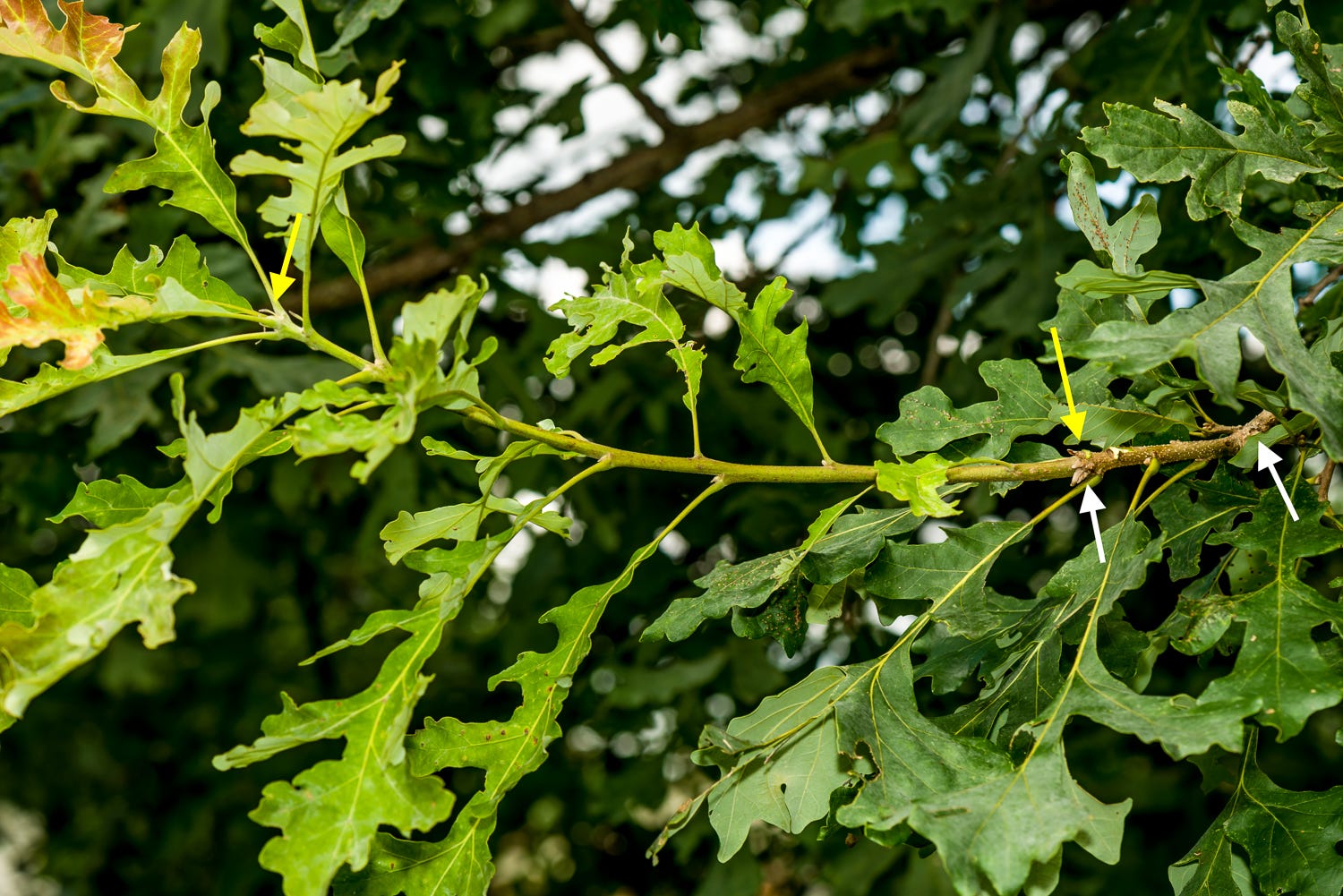
Let me summarize with following diagram. A bur oak opened its buds in the spring in response to warm weather, and made out a new shoot (between the white arrows). As soon as last year’s leaves and shoot had expanded, growth stopped and a new bud formed. Then, rain returned after a period of dry weather, and the bud opened. New growth (between the yellow arrows) then formed.
We mustn’t be complacent just because conditions for tree growth have improved in recent years. Climate change creates conditions in which both rainfall and drought are more frequent. We could easily, and probably will, have a significant drought soon. At the beginning of my life in Kentucky, we had several years of severe summer drought, and my resarch group studied oak morality in those years. There is a solution to the climate crisis, and that is to end the use of fossil fuels.
Homework: I would like Our Trees readers to contribute to the science of these flushes. There is very little published literature or natural history narratives. I have only been making observations in Kentucky. It is easy to spot these recurrent flushes since, as we have seen, they are usually pale compared with the first flush. So please, as you observe the trees near you, take some notes about what you are seeing - the species, the timing of the flush, and the color. Then report your observations here as a comment. It should be fun, and can really help us understand this impact of climate change. It may be too early in the growing season, but we will keep the comments open until the end of the season.
References:
Gaytán, Á., Moreira, X., Castagneyrol, B., Van Halder, I., De Frenne, P., Meeussen, C., ... & Tack, A. J. (2022). The co‐existence of multiple oak leaf flushes contributes to the large within‐tree variation in chemistry, insect attack and pathogen infection. New Phytologist, 235(4), 1615-1628.
I have noticed this condition this week, and then your post popped up and explained it. It seems quite prevalent this year. I'll try a leave an observation.
I have noticed a huge uptick in growth rate among my trees. Are you measuring trunk and branch caliper? From my amateur view, the trees I am observing are making startling gains in girth in both.