
Purple Haze
When the redbuds bloom
The cherry trees in bloom get all the press, but there is one tree that we really should credit with bringing us spring. That tree is eastern redbud, Cercis canadensis. Here in the Bluegrass, it is one of the first trees to flower and puts on an amazing show.
Redbud is an abundant understory tree, often lining the edges of our forests in a haze of purple. Although it is a very common tree, its floral show is actually rather unusual. Let’s have a look.


Redbud is a small tree that flowers in early spring. The entire tree flowers all at once. The individual flowers are elegant in shape and color. Like other members of the legume family, Fabaceae, redbud flowers are bilaterally symmetrical. What is more unusual is that the trees bear flowers all over the main stem and branches. Botanists call this cauliflory, bearing flowers on the main stem, and ramiflory, bearing flowers on the branch stems.
Cauliflory and ramiflory are very rare in temperate trees, and very common in tropical trees. There appear to be several advantages for a tree to flower this way. One is apparency, making the flowers more visible to pollinators, and the fruits more visible to animals that may disperse the seeds. This is an advantage in the extremely dense tropical forest.
Another advantage to cauliflory and ramiflory is to support large, heavy fruit that might break a smaller branch. Here, for example, is a cacao tree bearing large, heavy fruit on the main stem. These fruits would easily break a leaf-bearing branch.
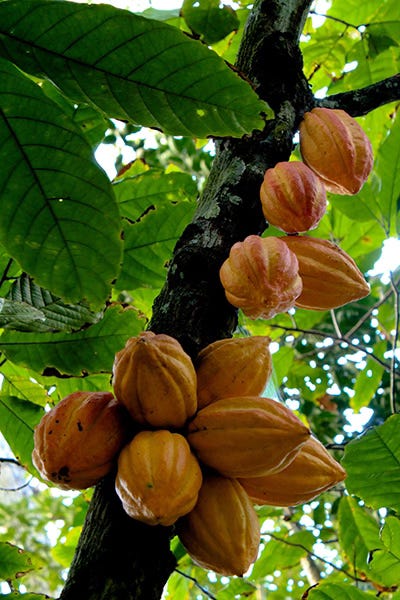
In the tropical forests of Indonesia and Malaysia, where I lived and worked, I saw many trees with this kind of floral and fruit display. But redbud is the only tree with this flowering pattern in our temperate forests. If you can think of others, please let us know in the comments.
Let’s now consider these trees from a pollinator standpoint. The literature tells us that bees are the most common pollinators, particularly long-tongue bees like honeybees (Apis), bumblebees (Bombus), and mason bees (Osmia). Short-tongue bees like mining bees (Andrena) are said to be less effective pollinators of long flowers.
I have had the opportunity to observe pollinators and redbuds. On my farm where I kept half a dozen beehives, I observed several nearby redbuds. I never saw honeybees on my redbuds. This may reflect the early flowering of redbuds, when populations of honeybees are still low. A few weeks later, my honeylocust trees would be covered in honeybees. Later, I kept mason bees to pollinate my orchard trees, but again, I rarely saw them on the redbuds in my yard. I do often see Andrena bees on redbuds. Butterflies and hummingbirds feed on the nectar, but I don’t know if they are efficient pollinators. Without studying redbud pollination more systematiclly, I remain uncertain about the pollinators and their behavior.
As noted above, cauliflory and ramiflory may also help trees by attracting animals that disperse their seeds. That is not clear in redbud. As the pods open, songbirds and squirrels eat the seeds. In my yard, harvest and spread of fruits was mostly due to my children. My kids decided, on their own I assure you, that redbud pods could serve as money in their backyard games. They were easy to pick off the tree trunks, and robust enough to stand up to serious play.
In spite of these uncertainties about the floral behavior of redbud, it is a tree we can all enjoy. The flowering season is done now, and the redbuds are leafing out, but they remain gorgeous all year. I hope you enjoy them as much as I do.
Your comments on redbuds are welcome.
Now, ‘scuse me while I kiss the sky.
These photos are gorgeous. I gifted my mom one of these a few years ago and it brings her a lot of joy when looking out the back window.
I learned about redbuds from my mother who grew up in Indiana and loved them above all Spring-flowering trees.